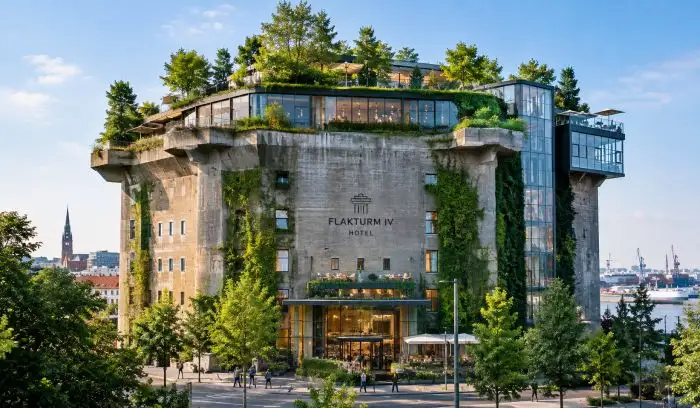
Hamburg has a strange, wartime history and a vastly different contemporary existence, in a building that is remarkable. The WWII bunker hotel was originally the air-raid fortress Flakturm IV constructed during WWII in Hamburg. The bunker was built to protect the city against Allied bombing, and was capable of holding several thousand people, coupled with its own power, water supply and hospital.
Following the war, the massive concrete building remained after demolition, and was gradually repurposed. It developed into a creative hotspot, media centre, music venue and a cultural venue over the decades. It is now a transformed structure whose imposing wartime presence is now replaced and it has a new identity.
Adolf Hitler orders construction
After Allied air raids on Berlin in 1940, Hitler ordered the German city to be protected with flakturms or flak towers. Albert Speer's chief architect Friedrich Tamms planned the defensively impenetrable towers, and by 1943, officials announced extension plans for Hamburg's port area a prime strategic target for many of the city's most important U-boat and oil production industries.
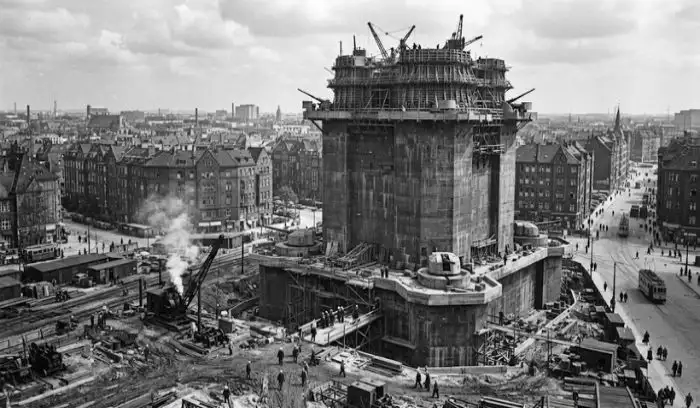
Workers built Flakturm IV from 2,400 forced labourers in Hamburg between 1942 and 1943 on the Heiligengeistfeld ('Holy Ghost Field') in the St Pauli district of the city.
Read More: Most Terrifying Attractions in the World: Explore If You Dare
A near-invincible fortress
Absolutely self-reliant, the mountain fortress boasted its own electrical power and fresh water supply, along with a fully equipped hospital featuring 95 beds, and four enormous anti-aircraft guns positioned on the roof to blow away any attacking Allied bombers.
Flakturm IV stood as one of the largest underground bunker complexes ever built, measuring 246 feet by 246 feet (75m by 75m) at its base and towering to a remarkable height of 125 feet (38m). Its robust walls measured 11 feet (3.5m) thick, while the roof received further reinforcement with an impressive 16 feet (5m) of solid concrete. Intended to provide shelter for 18,000 people, as many as 25,000 Hamburgers and some sources even claim as many as 60,000 hurried into the bunker during the ferocious Allied blitzkrieg attack in July 1943.
Spared destruction
Following the war, the authorities destroyed several Flakturms as part of the denazification process. They left Flakturm IV standing due to its role as a shelter for the many homeless Hamburgers during the war. Demolishing the building would have also necessitated devastating effects on large parts of central Hamburg that would have faced destruction from the explosive charge.
The building housed the founding of the publishing house Axel Springer in 1946, and in 1950, the public broadcaster NWDR transmitted West German television signals from the bunker for the first time. It also served as a women's shelter, a warehouse for teas and spices, and – once again – an air raid shelter when Cold War jitters intensified.
A creative hub
In 1956, the creative journey of the building began as a kreatibunker ('creative bunker') when fashion photographer F C Gundlach relocated his studio there. By 1975, the building became home to 15 firms, primarily consisting of photography and advertising agencies. In 1986, an additional 25 companies registered their operations at the building. That same year, violent anti-nuclear demonstrations erupted in the vicinity of the building.
In 1989, the decision-makers opted to demolish the structure amidst the global demilitarization that followed the fall of the Berlin Wall and the conclusion of the Cold War. However, they ultimately decided to retain the building, mainly because the great expense required for its demolition was daunting, while for some, it remained an unsightly feature on the horizon, and they passionately desired to see it preserved.
The sound of music
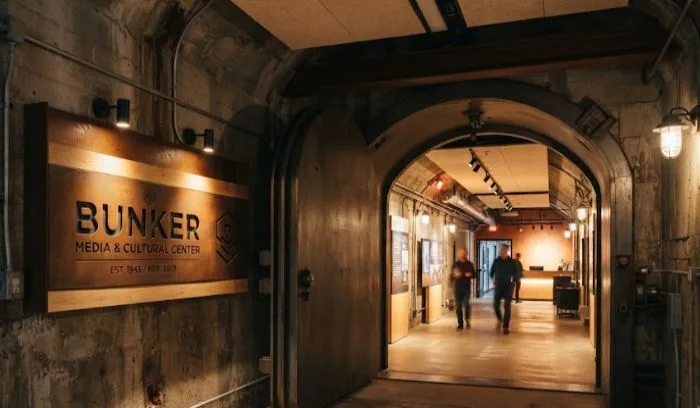
During the 1990s, developers converted the bunker into a state-of-the-art media and cultural centre. Investor Thomas Matzen secured a 60-year lease on the building in 1993 for 4.7 million ($6.2m) in 2024 money. In 1999, they established Nightclub Js within the building's premises.
In the year 2000, a grenade attacks targeted Nightclub J's VIP lounge, which left nine people, including Chris Harms, singer of the dark rock band Lord of the Lost (who later represented Germany at Eurovision 2023), seriously wounded.
You May Also Read: 8 Underrated Places in Germany You Should Explore
The bunker and The Beatles
In reality, the bunker and its environs have always been associated with music and entertainment. The Hamburger Dom fair has taken place on the Heiligengeistfeld since 1893. Heiligengeistfeld is also a place where photographer Astrid Kirchherr took her first pictures of The Beatles in 1960 during the band's time in Hamburg.
The photographer took the photos a short walk from the bunker. The Beatles began their career in the St Pauli district, playing at the Indra, Kaiserkeller, Bambi Kino and Top 10 clubs.
The world's first chamber concert club opens
In 2014, the bunker cemented its reputation for music and art when it opened the Resonanzraum in the building. Claiming to be the world's first chamber concert club and serving as the home of the classical Ensemble Resonanz, the Resonanzraum has attracted numerous classical and jazz concerts, experimental productions and innovative collaborations with electronic musicians to its extraordinary space, featuring a flexible 340-seat hall and an equally intimate 70-seat salon.
An earlier idea to green the roof
The inspiration to go green already existed around the bunker. The Hamburger Abendblatt newspaper asked Friedensreich Hundertwasser, an artist from Austria, to design a new way of using the former air raid shelter in 1992.
In his artist vision, he would cover the bunker with trees, and his design was published in the Hamburg newspaper on 2 April 1992. The artist puts a lot of 'roof afforestation' into his work, which is a feature of his Hundertwasserhaus ('Hundertwasser house') in Vienna.
FAQs
1. What is the WWII bunker hotel in Hamburg?
It is the former Flakturm IV bunker in Hamburg’s St Pauli district. Built during World War II, the structure has since been transformed into a mixed-use cultural and hospitality destination.
2. Why was Flakturm IV built?
Flakturm IV was constructed as a massive air-raid and anti-aircraft fortress to protect Hamburg from Allied bombing during World War II.
3. How many people could the bunker shelter?
The bunker was originally intended to shelter around 18,000 people. During the heavy bombing of Hamburg in July 1943, reports say that tens of thousands sought refuge inside.
4. What is the bunker used for today?
The building has hosted creative businesses, media operations, music events and cultural activities. Its redevelopment has also added modern hospitality and public spaces.
5. Where is the WWII bunker located?
The historic bunker is located on Heiligengeistfeld in Hamburg’s St Pauli district, an area known for entertainment, music and cultural attractions.