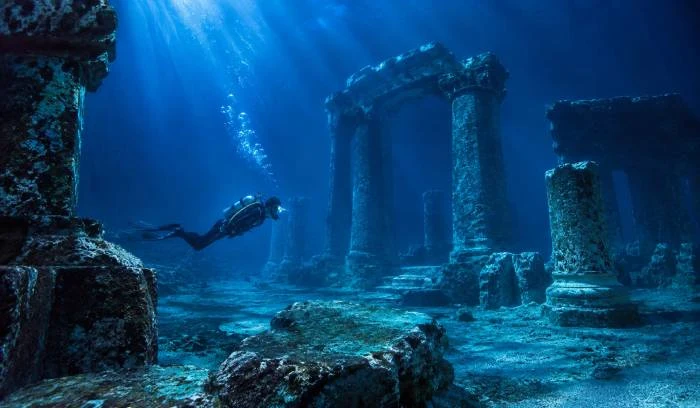
For decades, underwater cities have been intriguing explorers, archaeologists and history buffs. Scientists have found amazing underwater communities throughout oceans, lakes and rivers. From ancient villages and trading ports to towns that were purposely flooded to create dams and modern developments. Some go back thousands of years, others are not even around anymore a few decades ago.
The findings provide a unique glimpse into the daily life, community and adaptive responses of people. The ancient city ruins of Baia in Italy and the enigmatic Pavlopetri in Greece are just a few examples of underwater cities that have captivated the imagination with their long forgotten stories for centuries.
Water worlds
Our water bodies - our oceans, our rivers, and our lakes - house more than just wondrous sea monsters and enigmatic mammals. Explorers and divers have brought several lost underwater cities ones that we had thought were just works of fiction, until now back to the light. Some amazing monuments, lakes housing whole villages, and temples that rest in water can be found beneath the surface of this Earth.
Baia, Italy
Found beneath the surface of the Gulf of Naples and not a million miles away from the more popular 'lost' city of Pompeii, you will find the ruins of Baia (Baiae).
Much like its tragically equally doomed companion city, ancient Rome, Baiae became engulfed by volcanic action; however, unlike Pompeii, it didn't descend into hell in flows of lava. Instead, people from Baiae managed to escape the town prior to the waters coming up.
Read More: Steepest Streets in the UK and World: Lofty Lanes to Explore
Atlit Yam, Israel
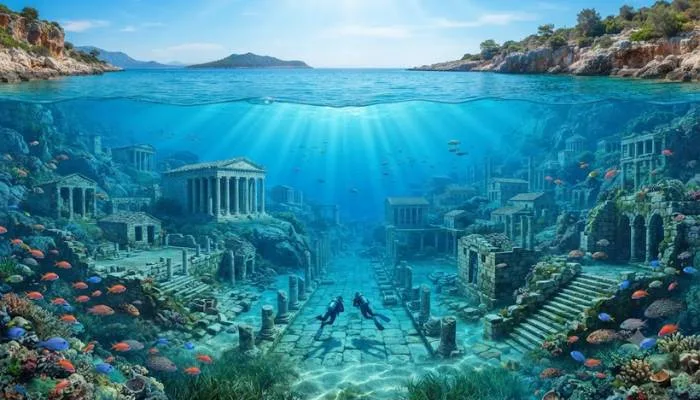
Archaeologists found these scattered remains of the Neolithic village in 1984, and they lie some way below the Mediterranean to the south of Atlit – Israel's north coast town just south of Haifa.
Researchers believe it existed between 6000BC to 7000 BC, and the submerged village is among the oldest ever found - and best-preserved. The site included stone wells, grain silos, the graves (with human remains), as well as an unknown stone circle discovered on the day of its discovery.
Pavlopetri, Greece
It remained there, hidden in sight until 1967 when a marine biologist from Southampton University, UK found it whilst diving in the bay. Nicholas Flemming returned with a party of students and uncovered a grid of streets, courts, and garden plots, stone houses, graves, and pieces of pottery from the Mycenaean era (1600 -1100 BC).
Shichang, China
Another Chinese 'Atlantis of the East' (a 16 th Century city deliberately submerged 50 years ago in 1959 to make way for the Xin'an Dam and hydroelectric station) is less of a mystery.
Many of the architectural buildings have apparently remained astonishingly preserved under the waters of the Qiandao Lake in Zhejiang province. All was lost until in 2001 a government expedition re-discovered the submerged city which consists of wide streets, stone walls and ornate gates and statues of lions, dragons and phoenixes.
Muang Badan, Thailand
Muang Badan means the ‘netherworld city’ - but during most of the time, the underwater place is a hybrid space of both water and land. The whole town drowned in 1984 when workers built the Vajiralongkorn Dam.
Even the houses and what was once the most notable feature the so-called Sunken Temple, built in the 1950s were put under water.
Simena, Turkeya
The crumbly ruins and stone buildings of the submerged town appear tantalisingly at and over the wave line, snaking into the turquoise waters of the sea from the rocky, northern shore of Kekova, a tiny, uninhabited isle just off Turkey’s coast near Antalya. The trading and military settlement, once a port, also served as ancient Lycian, and historians think that they founded it around 2,000 B.C.
Zakhiku, Kemune, Iraq
There are also several large buildings and even a palatial site with large surrounding walls. Among the excavated buildings are a large fortification with tall towers, a multi-story storage building, an industrial complex, and a monument.
You May Also Read: King Charles Vision: King Charles Sustainable Travel Initiatives
Port Royal
Formerly considered to be the most evil city on Earth, Port Royal in Jamaica was once the most profitable city in the Caribbean and by 1692, the greatest city of its time in that ocean area, but an earthquake induced a tsunami that claimed 2000 lives, swept the inhabitants, and in part reduced the buildings to rubble, which to this day remain under water beside the Palisadoes Strip at Kingston; just a tip of what was Port Royal remains.
The Lost Villages of Ontario, Canada
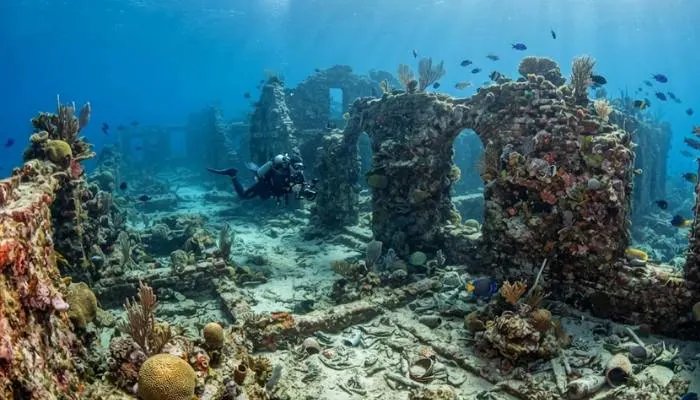
The 'Lost Villages' total up to a sum of 10 Canadian villages. The municipalities of Cornwall and Osnabruck in Ontario once incorporated these villages, which were inundated as a result of the construction of a shipping canal in the 1950s that necessitated the construction of a large dam across the St.
Lawrence River. Visitors can see parts of the villages -including sidewalks and structures- above the water surface at certain points above the water level.
Zakhiku, Kemune, Iraq
Five pottery jars that contained over 100 cuneiform texts, dating to the Middle Assyrian period, represented another exciting find at the site. Researchers hope that they may provide important evidence for the Mittani Empire as well as the assumption of Assyrian control.
As this area is prone to flooding, they could no longer expose the excavated buildings and covered them with plastic sheeting and gravel. Currently the site is completely under water once again.
FAQs
1. What is an underwater city?
An underwater city is a settlement, town, village, or group of structures that now lies beneath a body of water.
2. Which is one of the oldest underwater cities discovered?
Pavlopetri in Greece is one of the oldest known submerged settlements, with remains dating to the Bronze Age.
3. Why did some cities become submerged?
Cities became submerged for different reasons, including earthquakes, volcanic activity, rising sea levels, flooding, and the construction of dams.
4. Where is Atlit Yam located?
Atlit Yam is a Neolithic submerged settlement located off the Mediterranean coast of Israel, near the modern town of Atlit.
5. Can people visit underwater cities?
Some underwater sites can be explored through diving or boat tours, while others are protected archaeological sites and have restricted access.